Emotion Decoding in Individuals with Facial Palsy
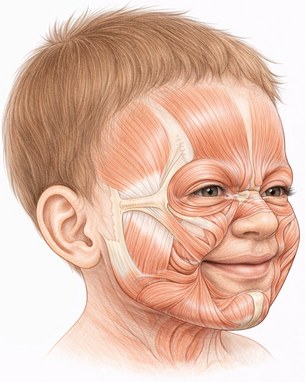
Facial expressions are both motor acts and powerful social signals. Our translational research investigates how an inability to produce facial movements affects the perception and recognition of other people’s emotions. Individuals with congenital facial palsy, particularly Moebius syndrome, provide a distinctive model for testing embodied-simulation and facial-feedback accounts.
Using behavioural testing, EEG, functional connectivity, neuroimaging and autonomic measures, we examine emotion recognition, the temporal processing of expressions and recruitment of sensorimotor networks. This work also informs rehabilitation: action observation, facial imitation and hand–mouth motor synergies are used to improve voluntary smile control following facial reanimation surgery.
Methods
- emotion-recognition and temporal-processing tasks; high-density EEG and functional-connectivity analysis; neuroimaging and autonomic measures; action-observation and imitation rehabilitation protocols; assessment of voluntary smile control after facial reanimation
Papers
| Reference | Topics | URL |
|---|---|---|
| De Stefani, E., Nicolini, Y., Belluardo, M., & Ferrari, P. F. (2019). Congenital facial palsy and emotion processing: The case of Moebius syndrome. Genes, Brain and Behavior, 18, e12548. | Emotion processing in congenital facial palsy. | |
| Sessa, P., Schiano Lomoriello, A., Luria, R., Mento, G., De Stefani, E., & Ferrari, P. F. (2022). Degenerate pathway for processing smile and other emotional expressions in congenital facial palsy. Cerebral Cortex, 32, 5282–5296. | Emotion-expression processing pathways. | |
| Quettier, T., Schiano Lomoriello, A., De Stefani, E., Ferrari, P. F., & Sessa, P. (2023). Testing EEG functional connectivity between sensorimotor and visual regions during face processing in congenital facial palsy. NeuroImage: Clinical, 38, 103399. | EEG functional connectivity during face processing. | |
| De Stefani, E., Barbot, A., Zannoni, C., et al., & Ferrari, P. F. (2022). Post-surgery rehabilitative intervention based on imitation therapy and mouth–hand motor synergies provides better outcomes in smile production in children and adults with long-term facial paralysis. Frontiers in Neurology, 13, 757523. | Rehabilitation after facial reanimation. | |
| Sessa, P., Schiano Lomoriello, A., Duma, G. M., Mento, G., De Stefani, E., & Ferrari, P. F. (2022). Degenerate pathway for processing smile and other emotional expressions in congenital facial palsy: an hdEEG investigation. Philosophical Transactions of the Royal Society B, 377, 20210190. | High-density EEG study of congenital facial palsy. | |
| Schiano Lomoriello, A., Caperna, G., Carta, A., De Stefani, E., Ferrari, P. F., & Sessa, P. (2024). Sensitivity to basic emotional expressions and the emotion perception space in the absence of facial mimicry: The case of individuals with congenital facial palsy. Emotion, 24, 602–616. | Emotion perception without facial mimicry. | |
| Sessa, P., Schiano Lomoriello, A., Quettier, T., Maffei, A., Costa, S., Nichele, M., & Ferrari, P. F. Facial palsy reveals the sensorimotor contribution to facial-emotion recognition. Proceedings of the National Academy of Sciences USA. | Sensorimotor contribution to facial-emotion recognition. |